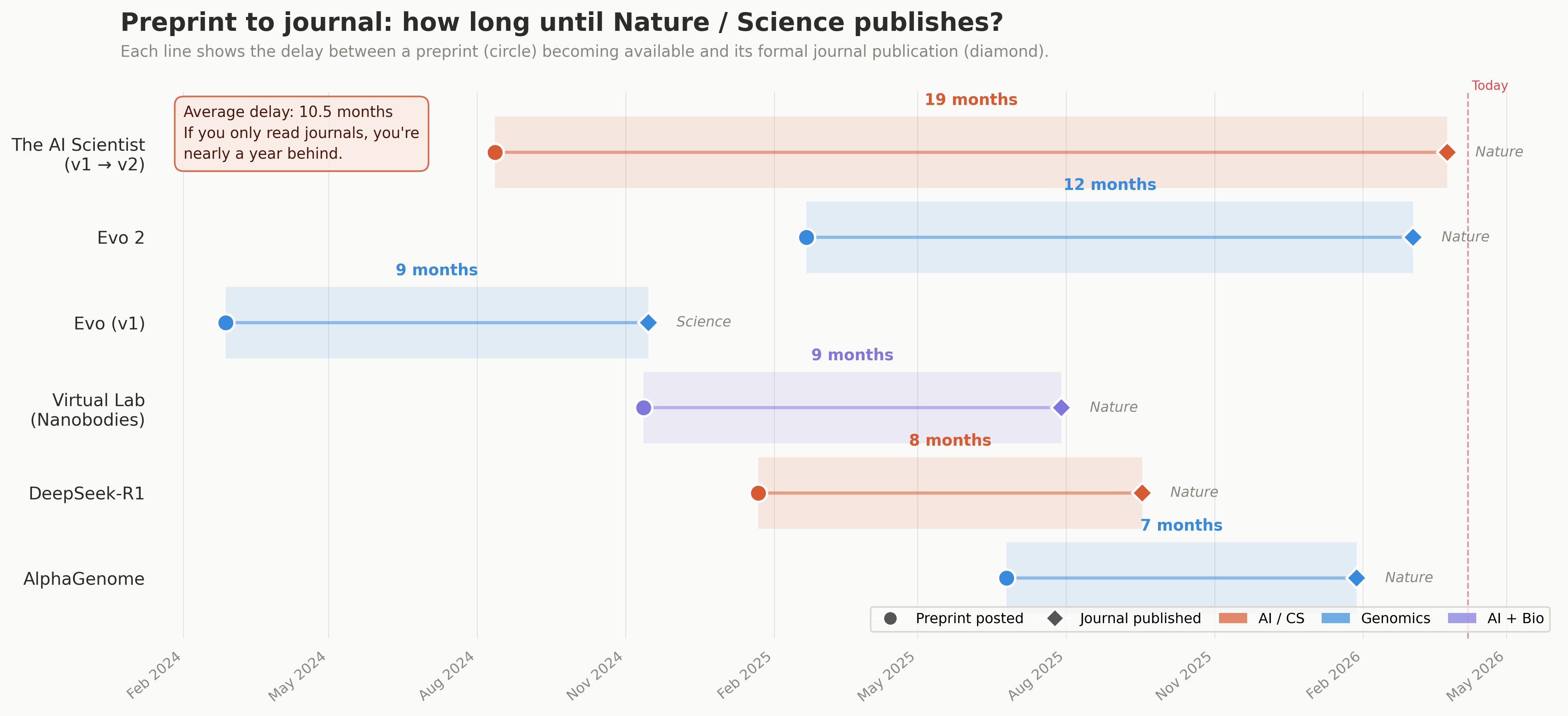
We tracked six landmark papers from preprint to journal publication. The results should alarm anyone who depends on traditional journals to stay current.
The AI Scientist -- posted on arXiv in August 2024 -- didn't appear in Nature until March 2026. That's 19 months. DeepSeek-R1 shook global markets in January 2025; Nature published it eight months later, in September. Evo 2, a foundation model trained on 9.3 trillion DNA base pairs, sat on bioRxiv for 12 months before Nature ran it. AlphaGenome, the Virtual Lab nanobody paper, Evo v1 -- every single one followed the same pattern. The average delay across this set: 10.5 months.
These aren't obscure papers. They're some of the most consequential scientific results of the past two years. And if you relied solely on Nature or Science to learn about them, you were nearly a year behind the people who actually read preprints.
The gap is getting worse, not better
Science moves faster than it did a decade ago. AI papers go from preprint to deployed product in weeks. Genomics models are being used clinically before the journal version clears copyediting. The traditional publishing timeline -- submission, desk reject or accept, two to four rounds of review, revision, proofs, embargo, publication -- was designed for a world where knowledge moved slowly. That world no longer exists.
The uncomfortable truth: peer review at traditional journals isn't slow because it's thorough. It's slow because the system wasn't designed for speed. Reviewers are unpaid and unaccountable to deadlines. Editors juggle formatting requirements that have nothing to do with scientific validity. Papers bounce between journals for months. The result is a system that routinely delays the certification of important science by half a year to over a year -- while the science itself has already been read, cited, built upon, and in some cases, commercially deployed.
Preprints won. The review layer didn't keep up.
The scientific community has already voted with its behavior. Researchers post preprints first because they know the work matters now, not in 14 months. Funders scan bioRxiv and arXiv because waiting for journal publication means missing the window to act. Investors moved billions on DeepSeek-R1 months before Nature weighed in.
But preprints alone aren't enough. They lack the structured expert validation that lets a non-specialist reader, a funder, a policymaker, or a clinician trust a result. The old model gave you rigor but no speed. Preprints gave you speed but no rigor. Neither option serves the people who need both.
This is why we built Alpha1 Science
Alpha1 Science exists to close that gap. We identify the top 1% of preprints using real-time scouting -- citation velocity, community discussion, institutional signal -- and route them to compensated domain experts for structured peer review in 21 days.
Not 8 months. Not 19 months. Three weeks.
Our reviewers evaluate what actually matters: reproducibility, validity, and significance. Not whether the abstract fits a word count. Not whether the figures conform to a house style. Not whether the authors should run one more supplementary experiment that won't change the conclusion. The science. That's it.
Authors retain full copyright. They can submit to journals concurrently -- our review is additive, not a replacement for journal publication if they want it. But by the time that journal version appears, the Alpha1 reviewed version has already been validated, cited, and put to use.
For the people who can't afford to wait
If you're a funder deciding where to allocate next quarter's grants, you need to know which science is real now -- not which science was real last year. If you're a researcher building on someone else's result, you can't wait 12 months for a journal seal of approval. If you're a biotech team evaluating whether to license a new method, the competitive window doesn't pause for peer review.
The six papers we tracked are proof of concept for a simple claim: the current system makes everyone wait too long for validation that could happen in weeks. The science doesn't need 10 months of review. It needs focused, expert evaluation by people who are paid for their time and held to a deadline.
That's Alpha1 Science. Rigorous review at the speed of discovery.
Kaimen Rigor, on the record.
Create a free Alpha1 account to run manuscript Kaimen Rigor reviews, publish citable records you can trust, take part in Formal Expert Review, and follow Alpha1 Selection.